

Bid the Job
Play as a student Run a game as instructor
How to run it
- Open the instructor page. Set the number of rounds, minutes per round, and group size, and turn distractors, overhead variance, and the client's price ceiling on or off. Create the game and you get a four-letter code.
- Students go to game.paulma.org on a phone or laptop, enter a name and the code, and wait in the lobby. You need at least two.
- Start the game. Each round, students cost the job and bid. Results show for thirty seconds and the next round starts on its own. At the end you can export every bid as a CSV.
What it is
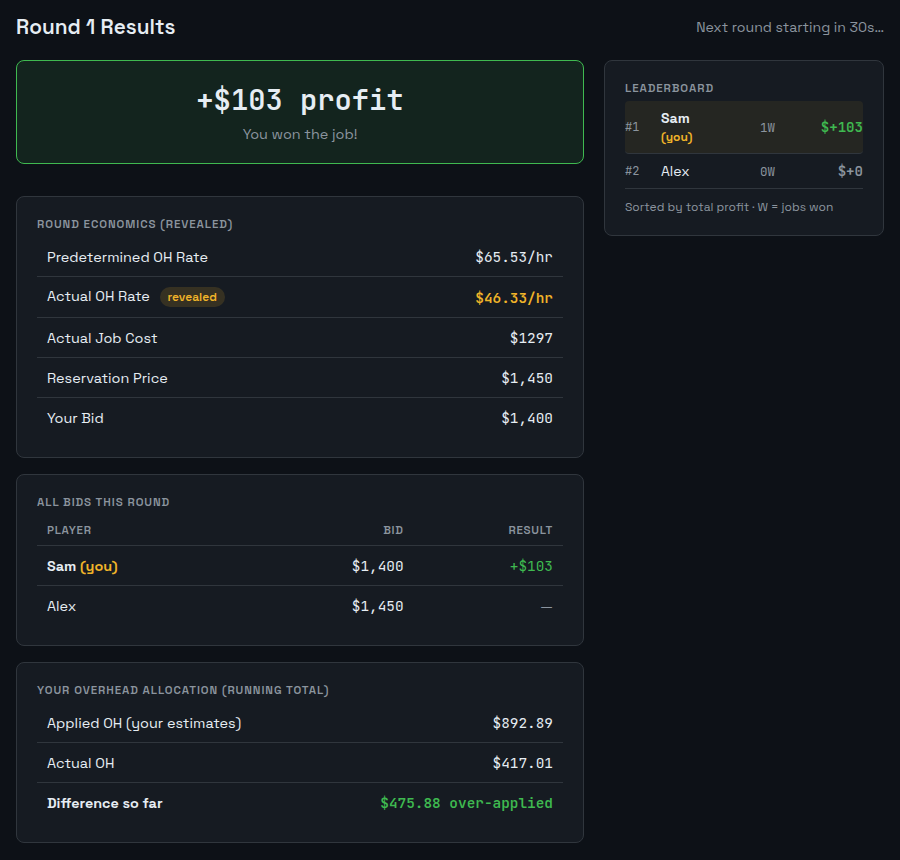
A classroom game I built for my cost accounting students. Each round, everyone gets the same job: a part for a space agency, a job sheet of materials and labor, and the shop's cost budget for the year. They have two minutes to cost it and bid. Students are randomly paired against each other, the lowest bid in each pair wins the job, and the profit or loss is booked against what the job actually cost, which nobody knows until the round ends. A live leaderboard ranks everyone by profit as the rounds go by, and the competition is what makes the game fun.
To bid well you have to do everything a job costing chapter asks for, in order and against a clock: decide which shop costs are overhead and which are a distractor, pick the right allocation base, compute the predetermined rate, apply it, and then decide how much margin to give up to win. The software only does the arithmetic. Every judgment is the student's.
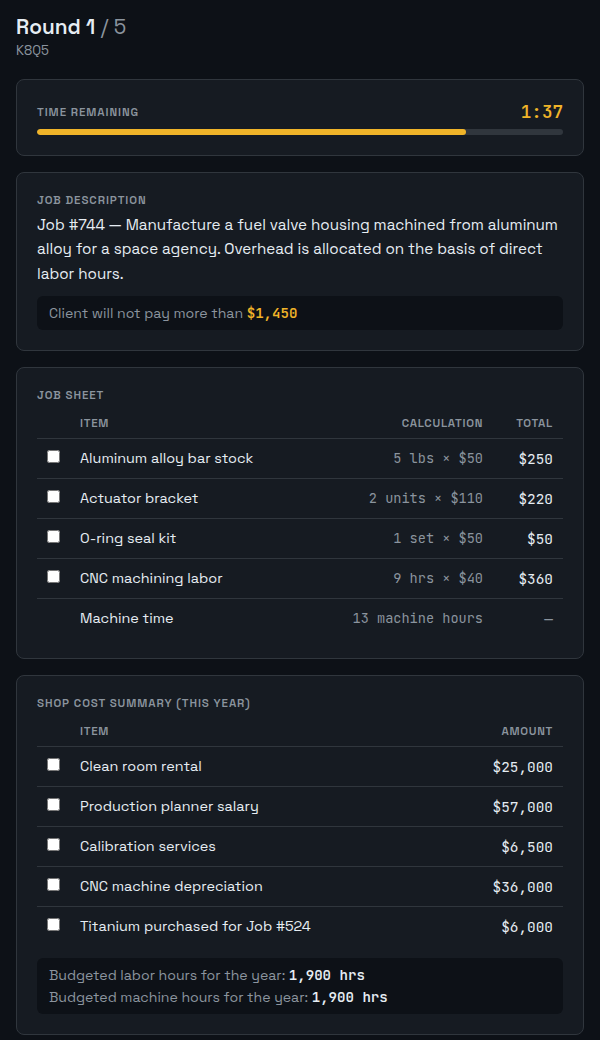
Luck is part of it. In the round below, Sam counted the titanium as overhead and used the wrong base, then won anyway because the actual overhead rate came in low. Over five rounds that stops working. The game ends by asking each student what to do with the overhead they over- or under-applied, which is the adjustment the textbook usually leaves for the last page of the chapter.
It runs in a browser on phones or laptops, with nothing to install. The instructor can turn distractors, overhead variance, and the client's price ceiling on and off separately, so the game gets harder as the course goes on.